Two Narratives of Memory and Identity. From Family Archive to Contested Territory
by Zoi Arvaniti
This project brings together two installations that explore memory through materials, surfaces, and fragments. Rather than presenting memory as a fixed record, the works approach it as something unstable, shaped by loss, proximity, and historical conditions.
The first work, I am afraid the details are fading away, is built from objects belonging to a family archive. These objects are placed behind a blurred plexiglass surface, where their outlines remain visible but their details begin to dissolve. The viewer encounters them at a distance, unable to fully grasp their form. Only at specific points—where the objects touch the surface—does clarity briefly emerge. This shifting visibility reflects the way memory operates: it preserves traces while allowing details to fade. What remains is partial, fragile, and dependent on contact.
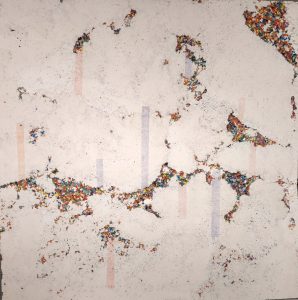
The second work, Etabli/Non Etabli, moves from personal memory to collective history. It refers to the population exchange between Greece and Turkey in 1923, where identity was defined through rigid categories. The terms établi and non-établi determined who would remain and who would be displaced. These words are handwritten on a cracked plaster surface, revealing layers of color beneath. The surface appears unstable, as if it could collapse or erase the words at any moment. This fragility reflects the arbitrary nature of imposed identities and the lasting effects of political decisions on lived experience.
Together, the two works move between the intimate and the historical, between objects and systems. They suggest that memory does not exist only within individuals, but emerges through material conditions and social structures. What persists is not a complete narrative, but a series of traces—fragments that continue to carry meaning even as they fade.